Developers and DevOps engineers don't really own their databases. They query the data and ship schema migrations, but they rarely maintain the database, tune its performance, or resolve the incidents when they appear. That work gets handed off—to an operations team, a database administrator, or whoever drew the short straw this quarter.
This division of labor felt reasonable when databases were a back-office concern. It doesn't hold up anymore. The systems we depend on—relational databases, search clusters like Elasticsearch and OpenSearch, streaming platforms—are now squarely on the critical path of the product. When they slow down, the product slows down. When they fail, customers feel it immediately. Treating them as someone else's problem is no longer a viable operating model.
This article makes the case for a shift in ownership, and lays out the three pillars that make that shift sustainable: database-aware observability, good processes, and the right mindset.
Why We Need a Shift in Ownership
The traditional handoff creates a gap. The people who understand the application best—how queries are shaped, what the data means, which access patterns matter—are the furthest removed from the system actually serving that data. Meanwhile the people closest to the database often lack the application context to interpret what they're seeing.
That gap is expensive. It shows up as slow incident response, because resolving anything requires pulling several people into a thread and reconstructing context from scratch. It shows up as recurring problems that never get fixed at the root, because nobody fully owns the outcome. And it shows up as wasted spend, because no one with both the context and the authority is watching whether the cluster is right-sized.
Shifting ownership toward the teams who build on top of the database closes that gap. But ownership without the right support is just a heavier pager rotation. To make it work, you need three things in place.
The Three Pillars of Database Ownership
Pillar One: Database-Aware Observability
You can't own what you can't see. The first pillar is observability—but not the generic, dashboard-everything kind. It has to be database-aware: built with tooling that understands the specific system you're running, its internals, and its failure modes.
Generic infrastructure metrics—CPU, memory, disk—tell you that something is wrong, but rarely what or why. Database-aware observability goes further. For a search cluster, that means understanding shards, segments, heap pressure, query latency distributions, indexing throughput, and the relationships between them. It's the difference between "heap usage is high" and "this query pattern is driving garbage-collection pauses on these two nodes."
What database-aware observability brings. Done right, observability gives you a coherent story rather than a wall of raw metrics. Instead of staring at graphs and guessing, you get an explanation of what happened and why—framed in terms you can act on, and connected to the business impact rather than isolated from it. That clarity directly reduces both mean time to detect (MTTD) and mean time to repair (MTTR): you spot problems earlier and you resolve them faster, because the diagnosis is half-done by the time you start.
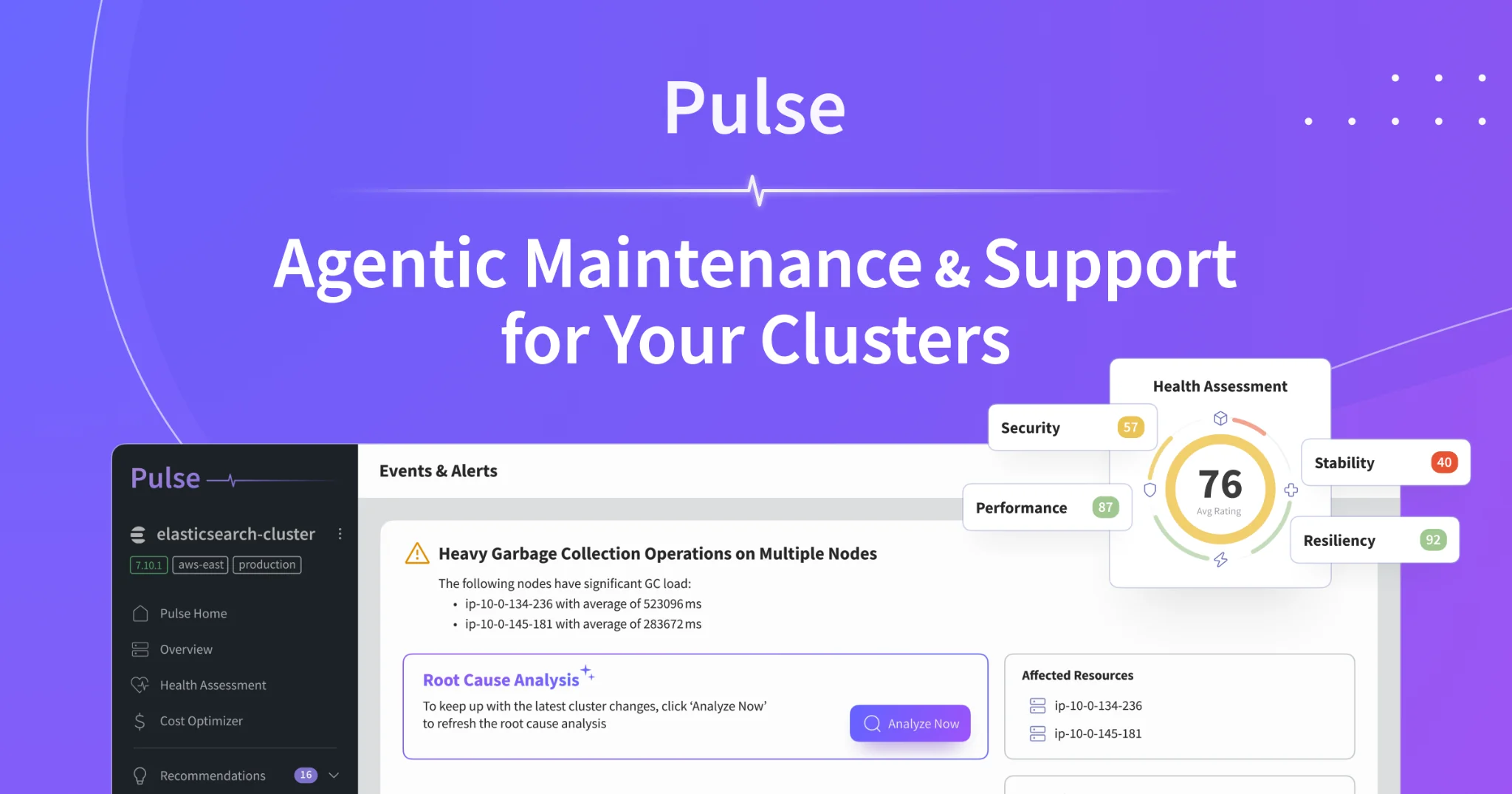
How Pulse helps. This is the core of what Pulse does for Elasticsearch and OpenSearch. Pulse provides real-time health assessments and proactive monitoring built specifically for search clusters—not a generic metrics agent pointed at a database it doesn't understand. It surfaces issues with the context needed to act, and its AI-powered insights translate cluster signals into a plain explanation of what's happening and what it means for your workload.
Pillar Two: Good Processes
Visibility tells you what's wrong. Processes determine whether you fix it reliably—or scramble every time. The second pillar is the set of repeatable practices around the database: how you respond to incidents, how you make changes safely, how you decide what to change, and how you keep that knowledge from living in one person's head.
Good processes are what separate a team that handles its tenth incident calmly from one that treats every incident as a novel emergency. They cover the boring-but-essential work: maintenance routines, change validation, capacity planning, and a clear path from "an alert fired" to "the right person is acting on the right information."
What good processes bring. The biggest payoff is fewer people in the loop. When the team that owns the system also has the tooling and the playbooks to act, an incident doesn't require assembling a committee. Less communication overhead means a shorter path to resolution—another direct cut to MTTR. Good processes also make outcomes consistent: results stop depending on which engineer happened to be on call.
How Pulse helps. Pulse supports better processes by turning monitoring data into specific, actionable recommendations rather than leaving teams to interpret raw metrics on their own. It catches issues early, before they escalate into incidents, and—on the plans that include it—gives teams direct access to BigData Boutique's search experts when a situation genuinely needs one. The effect is fewer fire drills and a repeatable way to keep clusters healthy.
Pillar Three: The Right Mindset
The third pillar is the hardest to install because it isn't a tool or a runbook—it's a posture. Owning a database means treating its health, performance, and cost as your responsibility, not as something that happens to you. It means being proactive instead of reactive: investing in prevention, paying down operational debt, and caring about efficiency even when nothing is on fire.
What the right mindset brings. A proactive mindset changes the economics of operations. Reactive teams spend their time firefighting, which crowds out the improvements that would prevent the next fire. Teams that own their systems break that cycle—they fix root causes, right-size their infrastructure, and steadily reduce both incidents and cost. The work shifts from "keep it alive" to "make it better," which is also a far better experience for the engineers doing it.
How Pulse helps. A proactive mindset is only practical if proactive work is actually feasible, and that's where good tooling matters. Pulse makes prevention the path of least resistance: it flags problems before they become outages, highlights resource waste so you can right-size your deployment, and provides the expert context that gives teams the confidence to act early rather than wait for things to break. It lowers the cost of doing the right thing.
What to Do Next
Owning your databases isn't a single decision—it's these three pillars reinforcing one another. Observability gives you sight, good processes turn sight into reliable action, and the right mindset keeps you investing before problems force your hand. Remove any one and the other two weaken: visibility without process is noise, process without the right mindset decays, and mindset without visibility is good intentions with no traction.
If you run Elasticsearch or OpenSearch, the fastest way to put all three into practice is to start with the pillar that's easiest to adopt: visibility. See what Pulse surfaces about your clusters, and use that clarity as the foundation for the processes and the proactive culture that follow.