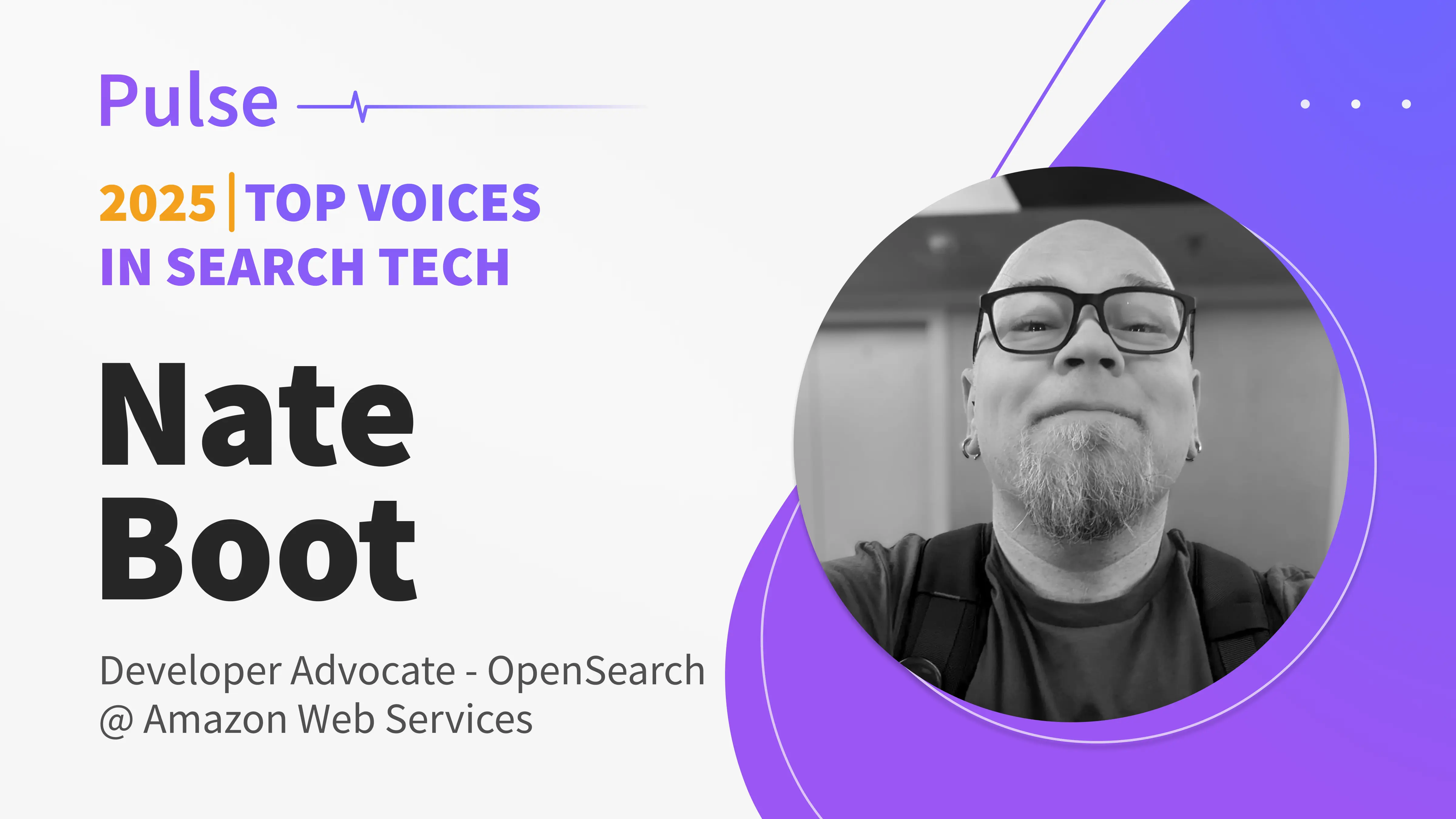
About Nate
Nate Boot is a developer advocate for OpenSearch with a background in DevOps and Linux and was recently named to the inaugural group of OpenSearch ambassadors. At AWS for nearly a decade, he helps users understand and adopt OpenSearch through user groups, conferences, and community support. He’s also a fan of retro tech, so ask him about old video games if you catch him with a margarita in hand.
Where to find Nate (and his work) on the web:
- opensearch.org
- The Linux Foundation
- https://github.com/opensearch-project
- https://www.linkedin.com/company/opensearch-project/
Let’s start from the beginning - how did you get involved in the search tech industry?
Very suddenly and serendipitously. I joined OpenSearch almost at the same time as our 1.0 release after a referral from our amazing community manager, Kris Freedain. I drank from the firehose just long enough to make myself useful, answering questions and building demos. The firehose never stopped. It reminds me of being taught how to swim by being thrown into a lake. The swim back to shore isn't so bad once you get out of the gunny sack.
Tell us about your current role and what you’re working on these days.
I'm fairly new to the realm of developer advocacy/relations. I've spent the majority of my career between development and tech specialist jobs, always with the goal of being involved in open source software in some form or fashion. Until I joined OpenSearch, that has always been in the form of using open source software pragmatically and demonstrating its potential impact on business through careful and intentional usage.
Now, along with a healthy dose of imposter syndrome, I can say that I'm supporting some of the "front lines" of open source software by trying to get people involved.
I'm still doing my best to fill the role of a developer advocate. I fear no stage, and it's very important that people see functioning examples of OpenSearch in action. I have a cycle that I tend to follow where I hyperfixate on some component of OpenSearch, learn and study, and then play show and tell afterwards.
Can you describe a ‘favorite failure’ - a setback that ultimately led to an important lesson or breakthrough in your work?
Yoda says "The greatest teacher, failure is" - every failure being just another nail we use to build a house of knowledge. That knowledge isn't always about your professional work life, but about yourself. How to stay moving in the face of failure or rejection. How to turn a short interaction into a seedling of content.
Is there a log error/alert that particularly terrifies/annoys you?
I don't know about alerts or logs, but I hate user interfaces that don't acknowledge button presses with visual indicators. Whether it's graying out the button you just clicked, or putting a spinner up on the page, or whatever.
Are there any open-source tools or projects - beyond Elasticsearch and OpenSearch - that have significantly influenced your work?
- sed
- awk
- nethack
- Always been a big fan of Ubuntu and Canonical.
What is the most unexpected or unconventional way you’ve seen search technologies applied?
I love seeing people apply search and analytics to video games and/or the related data. Whether it's building a helper application for an existing game or analyzing the results of e-sports competitions. Some racing games offer real-time telemetry that is really fun to play with.
What is a golden tip for optimizing search performance that you’ve picked up in your years of experience?
Oh, sorry. Was I supposed to have experience?
If you're building something from scratch - what does your ideal search tech stack look like?
I tend to focus on small proof-of-concept demos to take to tradeshows and user groups. These circumstances don't require anything too complex, so I end up with just a Node.js Express framework with just a handful of endpoints. Add a dollop of front-end javascript and a dash of CSS and HTML, and then flavor to taste. I don't need anything fancy.
Give us a spicy take/controversial opinion on something related to Search
People forget that the perfect search results are meant to inspire some kind of action, whether it's choosing a movie to watch, buying that perfect sweater with skulls on it, or finding that place to stay for a few nights. The search ends when your users or customers find what they want, not as a function of some particular relevancy score.
Anything else you want to share? Feel free to tell us about a product or project you’re working on or anything else that you think the search community will find valuable
I'll simply share this perspective - user interfaces are like jokes. If you have to take a bunch of time to explain them, they're probably not any good.