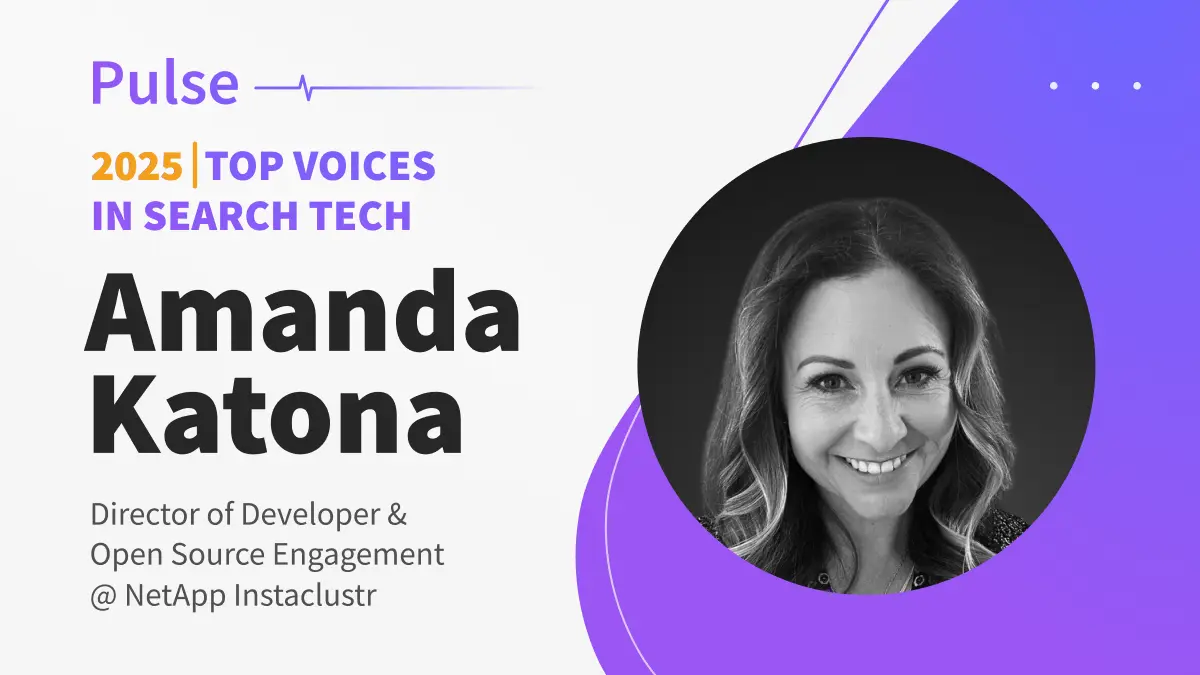
About Amanda
Amanda Katona is focused on growing the OpenSearch Foundation and expanding the adoption of OpenSearch worldwide. A community builder at heart, she designs programs that empower users and organizations to get the most out of search and AI. She’s also an adventure-seeker who finds inspiration in everything from Copenhagen dining to Utah mountain trails. Her notable achievements include guiding Harbor to CNCF graduation and spearheading marketing for SC19, the premier high-performance computing conference. Currently, she spearheads the developer and open source engagement team at NetApp Instaclustr.
Where to find Amanda on the web:
Connect with Amanda on LinkedIn
Let’s start from the beginning - how did you get involved in the search tech industry?
Much of my career can be attributed to being in the right place at the right time. When I first moved to San Diego, I took a temporary accounting admin job at Bakbone Software through an agency. During that hourly gig, I learned about an inside sales opening, and someone there believed I had what it took to learn backup software - even though I had never seen a data center before. We are still friends to this day. From there, the company was acquired, and I ended up following a colleague into the supercomputing industry, which introduced me to open source. That eventually led to my involvement with the Kubernetes community a decade ago. My love for open source communities flourished, and I’m continuing this work today with OpenSearch.
Tell us about your current role and what you’re working on these days.
I currently lead NetApp Instaclustr’s developer and open-source engagement team, and I truly love it. Our focus is on building and maintaining strong relationships with open source data and search infrastructure user and developer communities. I dedicate my efforts to growing the OpenSearch Foundation and expanding the global adoption of OpenSearch. It’s invigorating to work on a technology where AI is moving into production and making life incrementally easier - after all, everyone uses search!
Can you describe a ‘favorite failure’ - a setback that ultimately led to an important lesson or breakthrough in your work?
There are several to choose from here... I’ve learned three ultimate lessons in my career.
The first was over 20 years ago, when I used Salesforce.com data loader to load in new software renewal opportunity data and accidentally wiped out our Sales’ Opportunity forecast for the last week of the quarter. I obviously panicked at quarter-end, called our VP, and asked for help figuring out what to do. That VP of IT stayed up a lot of the night, manually re-entered the data one by one (since the fee was too high to roll back our SFDC instance), and surprised me the next day with the problem solved. This taught me why it’s so important to run tests before uploading data, but also taught me about camaraderie and that no matter how far up you are in a company you are, you can always roll your sleeves up to help out.
The second lesson is about the importance of sending a follow-up email when there’s an employee issue. I can’t go into much detail here, but it still haunts me to this day.
The third lesson is around setting boundaries and the importance of time off. When I decided to join Instaclustr, one of the recruiter’s selling points was that NetApp lives and breathes a company culture that values a true work-life balance. At this phase in my life, my family is at the forefront of my decisions. I’ve been here a year and a half, and I can honestly say I’m constantly excited about coming to work and just as excited for my upcoming vacation. When we bring new people onto the team, we kindly ask them not to mess up that culture... and then go through a vacation planning exercise at the end of each year to make sure people are making the most of life. We treat this as we would any other planning cycle, with lessons learned, what we need to do next time, and then thoughtfully plan time off. It really does keep innovation at the forefront – when you are more relaxed, cool ideas just can come to you!
What are some of the biggest misconceptions about search that you often encounter?
That vector search is the be-all and end-all.
Vector search is great, don’t get me wrong, but customers highlight limitations when using these systems for compliance, capturing business rules, and decision-making. When you take into account the full spectrum of what’s needed, there’s a place for both RAG and Graph to drive the speed of search.
How do you envision AI and machine learning impacting search relevance and data insights over the next 2-3 years?
Over the next couple of years, we are going to see big thinking in terms of viewing language-as-code in the same way we saw infrastructure-as-code start as a concept and then be used in production. When language is code, we are going to be living in a new world, like we saw in the movies when we were kids – I just hope it’s not like Wall-E.
Are there any open-source tools or projects - beyond Elasticsearch and OpenSearch - that have significantly influenced your work?
I am currently spending a lot of time providing feedback to OpenSearch on strategies to increase user adoption. Much of my input is informed by my experiences in the Supercomputing and Kubernetes communities, which remain highly influential in my work. The Supercomputing, or High-Performance Computing, space taught me the importance of explaining complex concepts in an easily understandable way. For example, much of the research in AI originated in this space before being adopted by commercial organizations. Similarly, the Kubernetes community continues to serve as a model for how to thoughtfully build an inclusive environment that fosters innovation.
What is the most unexpected or unconventional way you’ve seen search technologies applied?
This still cracks me up to this day... I work with a bunch of Australians who sent me this.
Give us a spicy take/controversial opinion on something related to Search
AI knows your friends better than you do.
Can you suggest a lesser-known book, blog, or resource that would be valuable to others in the community?
Since it’s the end of the year, I have been thinking a lot about predictions of where search is going and also spending time translating this into what skills my kid is going to need to learn in order to evolve with technology advances.
I really like the demo in this blog that shows how search can work in the future. Invisible by Design: Context-Aware Interfaces that Assemble Themselves - The Full Stop Thought - David vonThenen .
It shows how, yes, you will be able to speed up search to purchase, but that the code behind the search is checking prices at different websites before making the best purchase for you. I think this is what’s important to the next generation – still understanding the steps taken to figure out which website has the best price, but being able to make quick decisions.
Anything else you want to share? Feel free to tell us about a product or project you’re working on or anything else that you think the search community will find valuable
At the moment, we’re really focused on everything AI Search. Not just the new capabilities that it provides, but also making sure it stands up with mission-critical, production workloads. That's really what our customers are looking for from us, making sure everything works at scale.