Wix’s Big AI Engineering Announcement
Wix recently announced a structural shift in how it expects its engineering organization to operate in an AI-first environment. Predictably, much of the reaction focused on what this might mean for headcount and job security.
That focus misses the point.
The announcement wasn’t about reducing teams or replacing engineers. It was about redefining how engineering work is done as AI becomes a permanent part of the development process.
At its core, Wix is formalizing a model in which engineers are expected to work with AI systems by default. AI isn’t positioned as a productivity layer bolted onto existing workflows, but as infrastructure — something engineers are expected to reason with as part of their day-to-day work.
This shift reflects a broader change already underway across the industry. Engineering roles aren’t disappearing. They’re expanding, with broader ownership, higher expectations, and deeper reliance on specialized tooling.
Wix gave this shift a name: the xEngineer — an AI-native engineer with responsibility that spans the development lifecycle.
Why This Is Bigger Than Just Wix
While the announcement is specific to Wix, it’s notable because it shows how a large, mature engineering organization is thinking about AI beyond experimentation.
Instead of framing AI as a set of tools or initiatives, Wix framed it as an organizational change — one that affects how engineering work is defined, evaluated, and prioritized.
Large engineering organizations tend to formalize changes only after they’ve already proven out in practice. When roles and expectations shift at this level, it usually reflects pressures that are already present across the industry.
Wix was explicit that this shift is not about replacing engineers or reducing teams, but about changing how engineering effort is applied. Less time is expected to go toward low-leverage implementation details, with more focus on system design, architecture, reliability, and security.
Seen through that lens, the announcement reads less like a company update and more like a preview of where engineering roles are heading.
Where This Shift Shows Up First
When it comes to AI adoption, not all engineering domains are affected equally — especially in an xEngineer model where engineers are expected to take on broader ownership across the lifecycle.
If this shift is real and structural, it won’t appear everywhere at once. It will surface first in areas where complexity is high, signals are noisy, and better judgment has immediate production impact.
To see what that looks like in practice, it’s useful to look at another announcement from the same Wix team earlier this year.
Several months before the broader organizational change, Wix described how it had already begun introducing AI into parts of its CI/CD and reliability workflows.
The key insight was that not every aspect of CI/CD needs to be deterministic. While builds and deployments must remain predictable, tasks like interpreting logs, triaging failures, and recommending fixes operate in gray areas where AI’s pattern recognition is particularly effective.
Just as importantly, Wix was careful about boundaries. AI was not used to trigger deployments or make infrastructure decisions. It was used to guide the humans who do — reducing cognitive load and speeding up understanding without removing accountability.
Seen in that light, the broader xEngineer announcement becomes clearer. If engineers are expected to own outcomes beyond writing code, AI has to prove its value first in operational domains like DevOps — where understanding system behavior is the bottleneck, not execution.
What Wix’s Announcement Actually Signals
Taken together, Wix’s announcements point to three clear signals about how engineering work is evolving in an AI-first world.
First, xEngineer is now a real role model.
Wix may have named it, but many teams already feel the shift. Engineers are expected to think more broadly, own outcomes more fully, and work across traditional boundaries with AI as a built-in part of how they operate.
Second, specialization is shifting from people to tooling.
As engineers become broader, the tooling around them becomes deeper. Instead of relying on narrowly specialized roles for every domain, organizations are investing in system-aware tools that absorb complexity. The xEngineer isn’t a shallow generalist — they’re supported by increasingly expert tooling.
Third, operations is where this change is felt most strongly.
DevOps and SRE work already involves interpreting noisy signals, correlating events, and making judgment calls under pressure. These are exactly the conditions where AI can meaningfully assist without taking control.
How xEngineering Reframes Shift-Left
This evolution carries with it an important side effect: it reframes what “shift-left” actually means.
Historically, shift-left meant pushing responsibilities earlier in the lifecycle, often from DevOps or SRE teams onto developers, with the goal of reducing downstream friction. In practice, this frequently redistributed operational burden without redistributing context or tooling.
The xEngineer model changes that dynamic.
When engineers are expected to reason across development, operations, and reliability as a single responsibility, shift-left is no longer about moving tasks between functions. The boundaries between those functions are already breaking down. Shift-left becomes an inherent property of the role itself.
In some organizations, xEngineers will take on near end-to-end ownership of how their systems behave in production. They won’t be deep experts in every underlying technology, but they will be accountable for outcomes — which only works if AI tooling helps them reason about systems they don’t fully specialize in.
In other organizations, dedicated SRE, DBA, or platform teams will continue to exist. But their role changes. These teams won’t manage a single narrow technology in isolation. They’ll span multiple systems, rely on AI tooling by default, and depend on xEngineers to remain actively involved after code ships. Operational responsibility becomes shared rather than handed off.
In this model, the challenge isn’t expanding responsibility. It’s making that expansion sustainable with the right tools.
So shift-left tooling is no longer about exposing more dashboards to more people. It’s about enabling xEngineers — and the specialized teams working alongside them — to share understanding and operate from the same context.
Without that shared understanding, shift-left collapses into toil.
What AI Actually Changes for DevOps and SRE Teams
In practice, the first impact of AI in operational engineering is on time and attention.
Less time is spent manually parsing logs, correlating signals across tools, or acting as the first stop for every pipeline failure. That work doesn’t disappear — it becomes compressed.
AI absorbs much of the mechanical effort involved in detection, scoping, and initial root cause analysis. Engineers reach meaningful decisions earlier, with more context and less cognitive overhead.
This also changes how issues move through organizations. Instead of DevOps specialists being pulled in primarily to interpret noisy data, AI-assisted analysis surfaces clearer explanations earlier. The result is fewer escalations and fewer handoffs.
Wix’s CI/CD experience illustrates this well. Build failures that once required developers to contact DevOps engineers are now often resolved independently, with AI-powered analysis providing enough context to understand what went wrong and why. DevOps teams aren’t removed from the process — they’re removed from the bottleneck.
This is what makes broader ownership viable.
Why This Resonates With Us at Pulse
In that sense, Wix’s announcement doesn’t feel disruptive to us. It feels clarifying.
The industry is converging on a model where engineers take broader responsibility — sometimes directly, sometimes in close partnership with specialized SRE and DBA teams — but always with shared ownership of outcomes. That model only works when understanding moves earlier than problems do.
Pulse was built for exactly this reality. It’s an AI-powered SRE and DBA platform for teams running complex, business-critical Elasticsearch and OpenSearch deployments. From day one, the goal wasn’t to abstract these systems away or automate decisions for experts — it was to make expanded responsibility possible without pushing operational burden onto individuals.
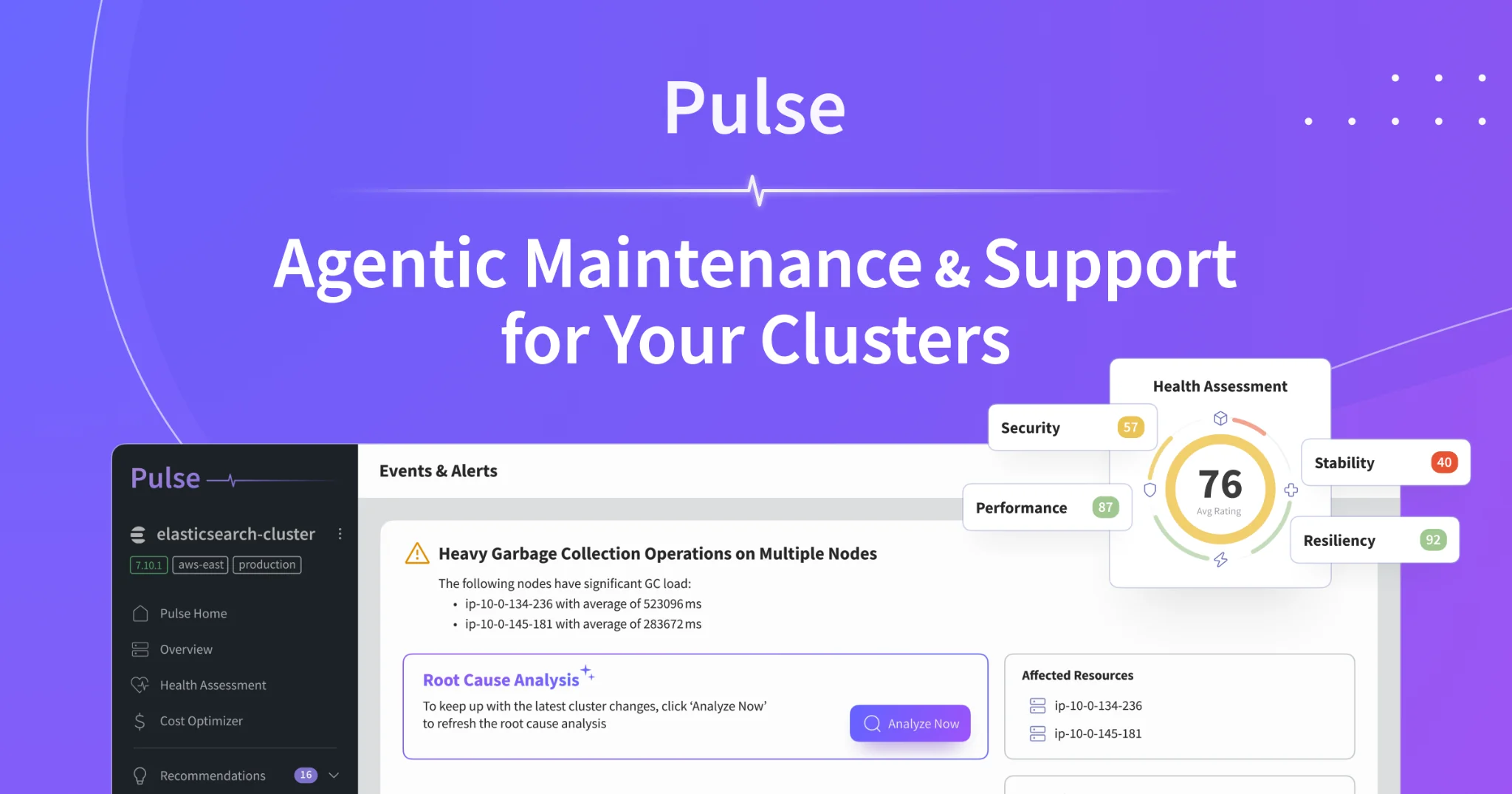
Pulse gives xEngineers and operational experts a shared, system-aware view of what’s happening. AI-powered root cause analysis compresses investigation time. Continuous cluster health checks establish clear system state. Purpose-built dashboards make complex environments legible across teams.
Our AI handles the heavy issue discovery and correlation, so expert humans can focus on judgment, tradeoffs, and response.
That’s what modern shift-left actually requires.
And that’s the intersection Pulse was designed to serve.